Computing Mismatches Between NR and EOB Waveforms
This tutorial demonstrates how to compute frequency-domain mismatches between Numerical Relativity (NR) waveforms and Effective One Body (EOB) model waveforms.
The mismatch quantifies how well an EOB model reproduces an NR waveform, accounting for:
Time and phase shifts
Total binary mass
Initial frequency
TODO: add references and extend example to higher modes
Setup
%matplotlib inline
%config InlineBackend.figure_format = 'retina'

import numpy as np
import matplotlib.pyplot as plt
from PyART.catalogs import sxs
from PyART.models import teob
from PyART.analysis.match import Matcher
from PyART.utils import utils as ut
import time
/opt/hostedtoolcache/Python/3.11.15/x64/lib/python3.11/site-packages/PyART/analysis/match.py:20: UserWarning: Wswiglal-redir-stdio:

SWIGLAL standard output/error redirection is enabled in IPython.
This may lead to performance penalties. To disable locally, use:

with lal.no_swig_redirect_standard_output_error():
    ...

To disable globally, use:

lal.swig_redirect_standard_output_error(False)

Note however that this will likely lead to error messages from
LAL functions being either misdirected or lost when called from
Jupyter notebooks.

To suppress this warning, use:

import warnings
warnings.filterwarnings("ignore", "Wswiglal-redir-stdio")
import lal

  import lal
Load NR Waveform from SXS
First, we load a numerical relativity waveform from the SXS catalog:
# Load SXS waveform
sxs_id = '0180'
nr = sxs.Waveform_SXS(
    path='./',
    download=True,
    ID=sxs_id,
    order="Extrapolated_N3.dir",
    ellmax=7,
    ignore_deprecation=True
)
nr.cut(300)  # Remove junk radiation

# Extract metadata
q = nr.metadata['q']
M = nr.metadata['M']
chi1z = nr.metadata['chi1z']
chi2z = nr.metadata['chi2z']
f0 = nr.metadata['f0']

print('==============================')
print(f'Mismatch for SXS:{sxs_id}')
print('==============================')
print(f'Mass ratio q : {q:.5f}')
print(f'Total mass M : {M:.5f}')
print(f'chi1z        : {chi1z:.5f}')
print(f'chi2z        : {chi2z:.5f}')
print(f'f0           : {f0:.5f}')
print('==============================')
---------------------------------------------------------------------------
ValueError                                Traceback (most recent call last)
Cell In[2], line 3
      1 # Load SXS waveform
      2 sxs_id = '0180'
----> 3 nr = sxs.Waveform_SXS(
      4     path='./',
      5     download=True,
      6     ID=sxs_id,

File /opt/hostedtoolcache/Python/3.11.15/x64/lib/python3.11/site-packages/PyART/catalogs/sxs.py:157, in Waveform_SXS.__init__(self, path, ID, order, level, cut_N, cut_U, ellmax, load, download, downloads, load_m0, nu_rescale, src, ignore_deprecation, basename)
    152     logger.info(
    153         f"The path {self.sxs_data_path} does not exist, contains no 'Lev*'"
    154         + "directory, or does not contain the requested order."
    155     )
    156     logger.info("Downloading the simulation from the SXS catalog.")
--> 157     self.download_simulation(
    158         ID=self.ID,
    159         path=path,
    160         downloads=downloads,
    161         level=self.level,
    162         ignore_deprecation=ignore_deprecation,
    163         extrapolation_order=order,
    164     )
    165 else:
    166     logger.warning(
    167         "Use download=True to download the simulation from the SXS catalog."
    168     )

File /opt/hostedtoolcache/Python/3.11.15/x64/lib/python3.11/site-packages/PyART/catalogs/sxs.py:343, in Waveform_SXS.download_simulation(self, ID, path, downloads, level, ignore_deprecation, extrapolation_order)
    341 # Save hlm data if requested
    342 if "hlm" in downloads:
--> 343     wav = sxs_sim.h
    344     extp = f"Extrapolated_N{extrapolation_order}.dir"
    345     to_h5file = {extp: {}}

File /opt/hostedtoolcache/Python/3.11.15/x64/lib/python3.11/site-packages/sxs/simulations/simulation.py:555, in SimulationBase.strain(self)
    552 @property
    553 def strain(self):
    554     if not hasattr(self, "_strain"):
--> 555         self._strain = self.load_waveform(*self.strain_path)
    556     return self._strain

File /opt/hostedtoolcache/Python/3.11.15/x64/lib/python3.11/site-packages/sxs/simulations/simulation.py:895, in Simulation_v2.strain_path(self)
    892 @property
    893 def strain_path(self):
    894     return (
--> 895         search_prefixes(
    896             f"Strain_{self.extrapolation}",
    897             self.sxs_id_stem, self.lev, self.files, ".h5"
    898         ),
    899         "/"
    900     )

File /opt/hostedtoolcache/Python/3.11.15/x64/lib/python3.11/site-packages/sxs/simulations/simulation.py:35, in search_prefixes(file, sxs_id_stem, lev, files, ending)
     33         if f"{fn}{ending}" in files:
     34             return fn
---> 35 raise ValueError(f"{file}{ending} not found in any form in files")

ValueError: Strain_NExtrapolated_N3.dir.h5 not found in any form in files
Generate Corresponding EOB Waveform
Now we generate an EOB waveform with the same parameters:
# EOB parameters
srate = 8192
eobpars = {
    'M': M,
    'q': q,
    'chi1': chi1z,
    'chi2': chi2z,
    'LambdaAl2': 0.,
    'LambdaBl2': 0.,
    'distance': 1.,
    'initial_frequency': 0.9*f0,
    'use_geometric_units': "yes",
    'interp_uniform_grid': "yes",
    'domain': 0,
    'srate_interp': srate,
    'inclination': 0.,
    'output_hpc': "no",
    'use_mode_lm': [1],
    'arg_out': "yes",
    'ecc': 1e-8,
    'coalescence_angle': 0.,
}

eob = teob.Waveform_EOB(pars=eobpars)
eob = eob * (q/(1+q)**2)

print("EOB waveform generated successfully")
EOB waveform generated successfully
Visualize Waveforms
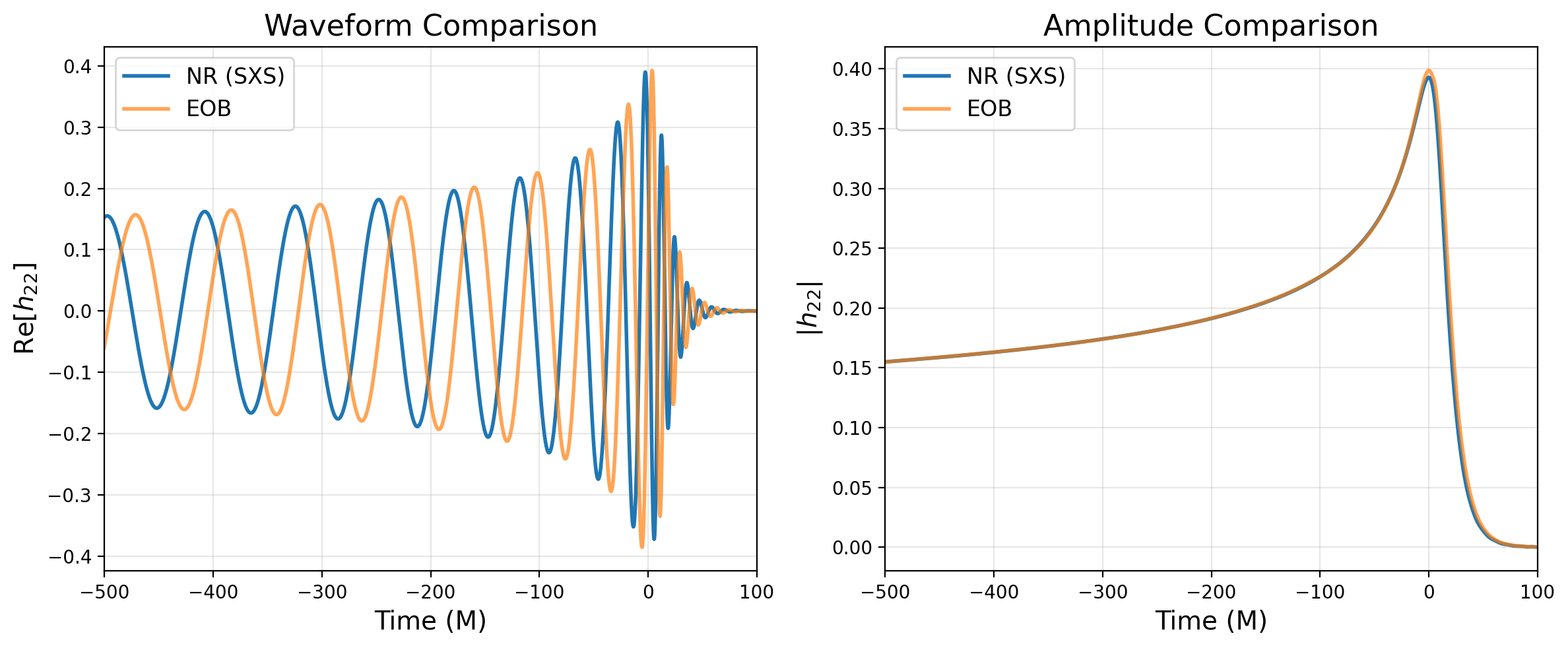
Let’s compare the NR and EOB waveforms visually:
# Find merger times
nr_mrg, _, _, _ = nr.find_max()
eob_mrg, _, _, _ = eob.find_max()

# Plot
plt.figure(figsize=(12, 5))

plt.subplot(1, 2, 1)
plt.plot(nr.u - nr_mrg, nr.hlm[(2,2)]['real'], label='NR (SXS)', linewidth=2)
plt.plot(eob.u - eob_mrg, eob.hlm[(2,2)]['real'], label='EOB', linewidth=2, alpha=0.7)
plt.xlabel('Time (M)', fontsize=14)
plt.ylabel(r'Re[$h_{22}$]', fontsize=14)
plt.title('Waveform Comparison', fontsize=16)
plt.legend(fontsize=12)
plt.grid(True, alpha=0.3)
plt.xlim([-500, 100])

plt.subplot(1, 2, 2)
plt.plot(nr.u - nr_mrg, nr.hlm[(2,2)]['A'], label='NR (SXS)', linewidth=2)
plt.plot(eob.u - eob_mrg, eob.hlm[(2,2)]['A'], label='EOB', linewidth=2, alpha=0.7)
plt.xlabel('Time (M)', fontsize=14)
plt.ylabel(r'$|h_{22}|$', fontsize=14)
plt.title('Amplitude Comparison', fontsize=16)
plt.legend(fontsize=12)
plt.grid(True, alpha=0.3)
plt.xlim([-500, 100])

plt.tight_layout()
plt.show()
Compute Mismatch vs Total Mass
The mismatch depends on the total mass of the binary because:
Different masses correspond to different frequency ranges
The detector sensitivity varies with frequency
Note that by default the mismatch is computed with the aLIGOZeroDetHighPower noise curve. You can change this by specifying a different noise curve in the settings dictionary.
Let’s compute the mismatch for a range of total masses:
# Define mass range
mass_min = 10   # Msun
mass_max = 200  # Msun
mass_num = 20
masses = np.linspace(mass_min, mass_max, num=mass_num)
mm = np.zeros_like(masses)

# Compute mismatches
t0 = time.perf_counter()
for i, M_total in enumerate(masses):
    f0_mm = 1.25 * f0 / (M_total * ut.Msun)

    matcher = Matcher(
        nr, eob,
        settings={
            'pre_align': True,
            'initial_frequency_mm': f0_mm,
            'final_frequency_mm': 2048,
            'tlen': len(nr.u),
            'dt': 1/srate,
            'M': M_total,
            'resize_factor': 4,
            'modes-or-pol': 'modes',
            'modes': [(2,2)],
            'pad_end_frac': 0.5,
            'taper_alpha': 0.20,
            'taper_start': 0.05,
            'taper': 'sigmoid',
            'cut_longer': True,
        }
    )
    mm[i] = matcher.mismatch

    if i % 5 == 0:
        print(f'M = {M_total:6.1f} Msun, f0 = {f0_mm:7.4f} Hz, mismatch = {mm[i]:.3e}')

elapsed = time.perf_counter() - t0
print(f'\nTotal elapsed time: {elapsed:.2f} seconds')
M =   10.0 Msun, f0 = 99.0953 Hz, mismatch = 5.795e-05
M =   60.0 Msun, f0 = 16.5159 Hz, mismatch = 1.176e-04
M =  110.0 Msun, f0 =  9.0087 Hz, mismatch = 1.253e-04
M =  160.0 Msun, f0 =  6.1935 Hz, mismatch = 1.234e-04

Total elapsed time: 10.42 seconds
Plot Mismatch vs Mass
plt.figure(figsize=(10, 6))
plt.plot(masses, mm, linewidth=2, marker='o', markersize=5)
plt.yscale('log')
plt.xlabel(r'Total Mass $M$ [$M_\odot$]', fontsize=16)
plt.ylabel(r'Mismatch $\bar{\mathcal{F}}$', fontsize=16)
plt.title(f'NR-EOB Mismatch for SXS:{sxs_id}', fontsize=18)
plt.ylim(1e-5, 1e-3)
plt.grid(True, alpha=0.3)
plt.tight_layout()
plt.show()

# Report statistics
print(f'Minimum mismatch: {mm.min():.3e} at M = {masses[mm.argmin()]:.1f} Msun')
print(f'Maximum mismatch: {mm.max():.3e} at M = {masses[mm.argmax()]:.1f} Msun')
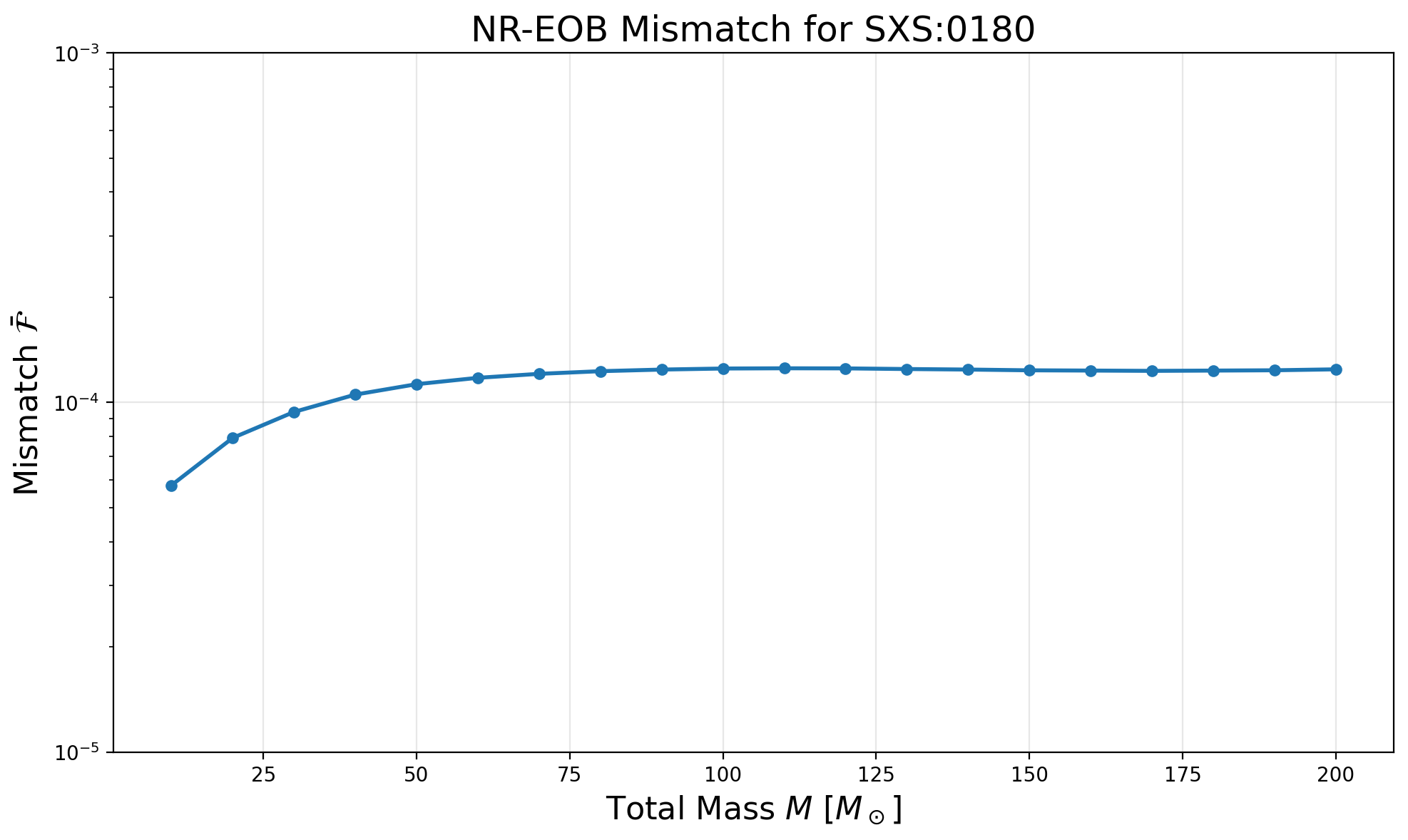
Minimum mismatch: 5.797e-05 at M = 10.0 Msun
Maximum mismatch: 1.253e-04 at M = 110.0 Msun
Summary
This tutorial demonstrated:
Loading NR waveforms from the SXS catalog
Generating corresponding EOB waveforms with matching parameters
Visualizing and comparing NR and EOB waveforms
Computing frequency-domain mismatches using the
MatcherclassAnalyzing how mismatch varies with total binary mass
Key Observations
Mismatches typically vary with mass due to different frequency ranges being probed
Lower mismatches indicate better agreement between NR and EOB
The
Matcherclass handles alignment, tapering, and frequency-domain operations automatically
Next Steps
Explore multi-mode mismatches
Try different PSD curves (aLIGO, Einstein Telescope, Cosmic Explorer)
Optimize EOB parameters to minimize mismatch (see optimizer tutorial)